Anticipating Vulnerable Users & Blind Hazards
Special Protections under Article 49 RVV 1990
Under Dutch traffic legislation, drivers must at all times give way to:
- Blind or Visually Impaired Persons: Anyone carrying a white cane with one or more red reflective rings, or accompanied by a certified guide dog in harness. This applies everywhere, whether a zebra crossing is present or not!
- Mobility Impaired Persons: Individuals who have difficulty walking (using crutches, a walking frame, or walking with visible difficulty).
Children in Traffic
Children under 12 years old have incomplete peripheral vision and difficulty judging vehicle speed and stopping distance.
- Near schools, parks, and residential play streets, expect children to run onto the road unpredictably.
- A rolling ball between parked cars: Always BRAKE IMMEDIATELY. A child running after it follows 90% of the time.
Fast Two-Wheelers: Speed-Pedelecs & E-Bikes
- High-speed e-bikes and speed-pedelecs (yellow moped license plate) travel up to 45 km/h.
- When turning right, look early in your mirror; an approaching speed-pedelec travels nearly as fast as your car!
Essential Statutory Rules (RVV 1990)
- Blind persons with a white cane with red rings or with a guide dog must always be given way when crossing (Article 49).
- Persons with mobility difficulties (walking frames, crutches) must be given way anywhere when crossing.
- School buses displaying flashing yellow hazard lights signal unpredictable children crossing.
- Speed-pedelecs (yellow plate) travel at up to 45 km/h; expect rapid closure rates.
A blind person carrying a white cane with one or more red rings, or walking with a guide dog, ALWAYS has priority when crossing anywhere!
Check Your Understanding (4Questions)
Immediate CBR validation with instant answers and statutory RVV 1990 legal context. Scores persist in your module dashboard.
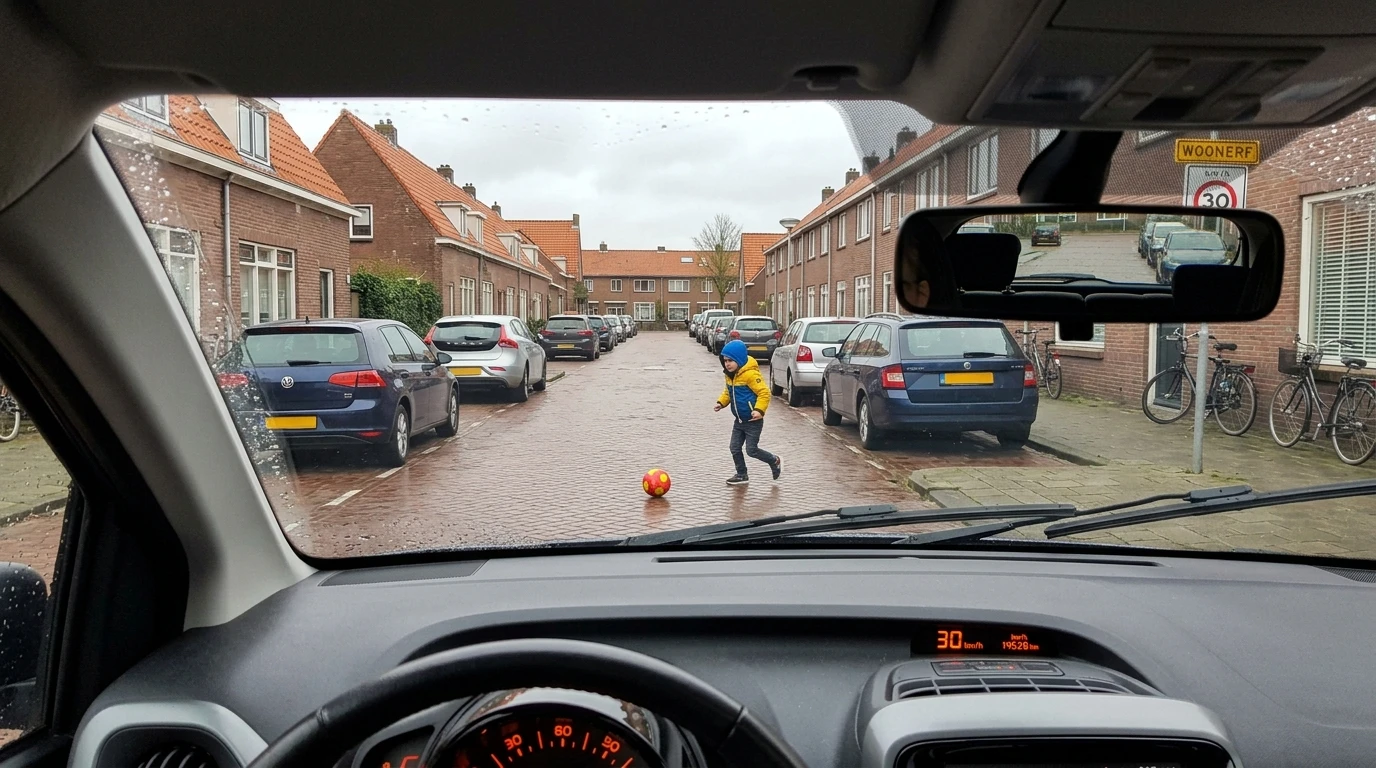
What do you do? (Speed: 20 km/h, living street / erf, playing children with scooters are on the pavement to the left behind brick planters).
What do you do? (Speed: 50 km/h, city road, you approach a green traffic light 10 meters away, a pedestrian waits patiently on the kerb looking down at their phone, road ahead is completely clear).
What do you do? (Speed: 80 km/h, country road, a deer emerges from the woodland on the right verge and pauses looking towards the road 30 meters ahead).
What do you do? (Speed: 100 km/h, motorway, entering a well-lit tunnel, traffic is flowing smoothly, car behind maintains 60 meters distance).