Motorway Merging & Acceleration Lanes
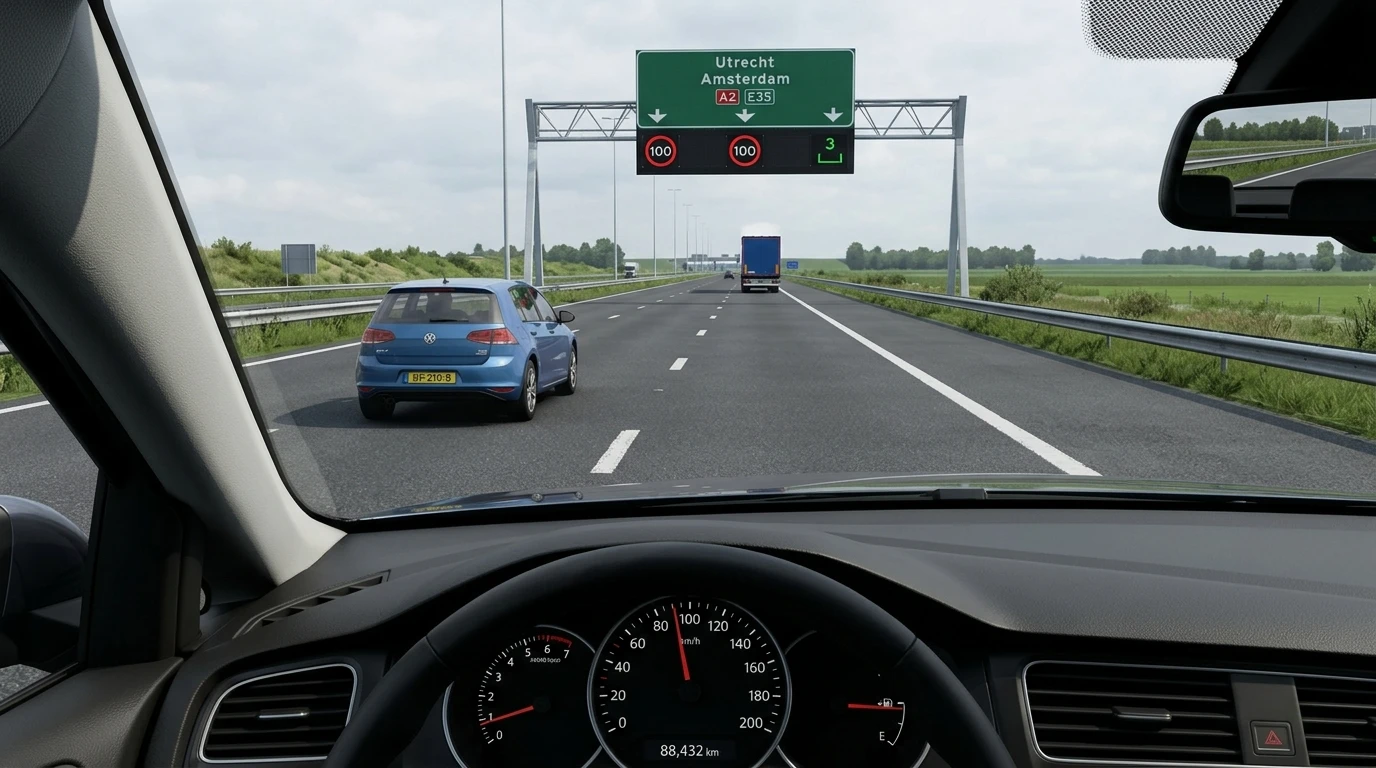
Motorway Merging (Invoegen)
Under Article 54 RVV 1990, merging onto a carriageway is classified as a special maneuver (bijzondere manoeuvre).
- You do NOT have right-of-way: Drivers already traveling on the motorway have absolute priority over you.
- Procedure:
- Accelerate briskly on the on-ramp and acceleration lane to match the cruising speed of vehicles in the right-hand lane (typically 90–100 km/h).
- Scan the traffic flow, rearview mirror, left side mirror, and check over your left shoulder into your blind spot.
- Signal left once a suitable gap is identified, and steer smoothly into the gap.
- Never come to a dead stop on the acceleration lane!
Daytime vs Nighttime Speed Limits
- Between 06:00 and 19:00: Standard maximum speed is 100 km/h on all Dutch motorways (Sign A1 with bottom plate ‘06-19h’).
- Between 19:00 and 06:00: Maximum speed returns to 130 km/h (or 120/100 km/h if permanently posted).
Essential Statutory Rules (RVV 1990)
- Merging is classified as a special maneuver under Article 54 RVV 1990: merging drivers must yield to all traffic on the main carriageway.
- Match speed to traffic flow before steering into the right lane.
- Never stop at the start of an acceleration lane; continue along the hard shoulder in rare emergency cases.
- Standard motorway speed limit: 100 km/h between 06:00 and 19:00; 130 km/h between 19:00 and 06:00 unless posted otherwise.
Drivers on the motorway are not legally required to move over to let you merge, although it is courteous.
Check Your Understanding (4Questions)
Immediate CBR validation with instant answers and statutory RVV 1990 legal context. Scores persist in your module dashboard.
You have broken down with your passenger car outside a built-up area where your stationary car presents a hazard to approaching traffic, and your hazard warning lights cannot be used. At approximately what distance (in metres) must you place the warning triangle towards approaching traffic? Enter the number in metres.
What is the maximum permissible blood alcohol concentration (BAC) for a novice driver (beginnend bestuurder) in the Netherlands? Enter the number in promille (‰).
What is the maximum permissible blood alcohol concentration (BAC) for an experienced driver (holding a category B driving licence for more than 5 years) in the Netherlands? Enter the number in promille (‰).
You are driving on a motorway in the right lane approaching an on-ramp where traffic is merging. A white van is accelerating on the entry slip road. Who has priority?