Road Surface Markings, Lines & Chevrons
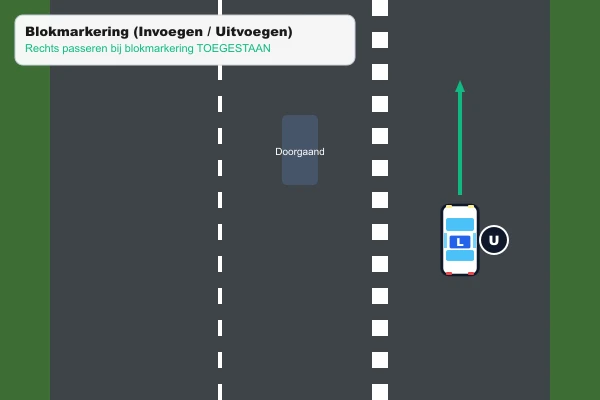
Solid vs. Broken Lines (Strepen)
- Solid White Line (Doorgetrokken streep): You may not cross or straddle a solid line. Exception: Only if an obstacle blocks the road and safety allows passing, or when leaving an emergency situation.
- Combination Lines: If a solid and broken line run together, follow the line on your side. If the broken line is on your side, you may overtake and return across the solid line.
- Hatch Markings (Verdrijvingsvlak): Road area marked with white diagonal slashes. Entering or driving over hatch markings is illegal.
Essential Road Design Markings (Essentiële Herkenbaarheidskenmerken - EHK)
- Double white dashed lines with GREEN center strip: Regional Autoweg (maximum speed 100 km/h).
- Double white dashed lines without green: Rural distributor road (80 km/h).
- No center line with dashed edge lines: Access road (60 km/h zone).
Essential Statutory Rules (RVV 1990)
- Solid white line (doorgetrokken streep): drivers may not cross it or drive over it (Article 76).
- Chevrons / Hatch markings (verdrijvingsvlak): drivers are strictly prohibited from driving, stopping, or overtaking on hatch markings.
- Green filled center strip: designates a 100 km/h provincial autoweg.
- Block markings (blokmarkering): indicate merging lanes and allow passing on the right.
If a solid line and broken line run side by side, you obey the line closest to your side of the road.
Check Your Understanding (4Questions)
Immediate CBR validation with instant answers and statutory RVV 1990 legal context. Scores persist in your module dashboard.
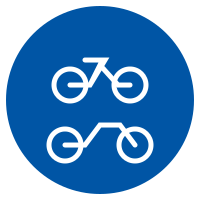
You approach an intersection displaying circular blue sign D1 with three curved white arrows in a circle. What does this sign indicate?
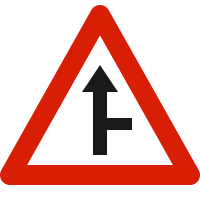
You arrive at an intersection equipped with octagonal stop sign B7 and a transverse white stop line. The intersecting road is completely clear with full visibility. Must you bring your vehicle to a complete stop?
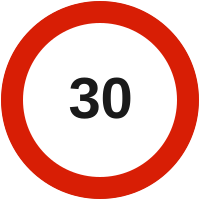
You enter an area marked with a rectangular sign displaying 'ZONE' above a red-bordered circle with '30'. When does this 30 km/h speed restriction end?
In the center of a two-way road there is a combination line: a broken line on your side and a continuous solid line on the oncoming traffic's side. Are you permitted to cross this line to overtake?